LEARNING OUT LOUD · POST TWO
I went looking for bedsheets and ended up on St. Helena Island.
Dr. Tyra Àkànké Washington · Creator of the B.E.S. Instructional Framework™
I wanted a new pair of bedsheets. I thought, if I’m buying quality, I should buy Egyptian cotton.
And just the thought of cotton took me back to the Penn Center.
This is how my social studies brain works. I can’t help it. And now you, the reader, will take this journey with me.
St. Helena Island
The Penn Center sits on St. Helena Island, South Carolina, in the heart of Gullah Geechee country. Penn School was founded there in 1862 — one of the first schools in the South built to educate people who had just been freed. Classes began in the Brick Church with eighty pupils. In 1864 the school bought its land from Hasting Gantt, a freedman. Formerly enslaved people did not only attend that school. One of them sold it the ground.
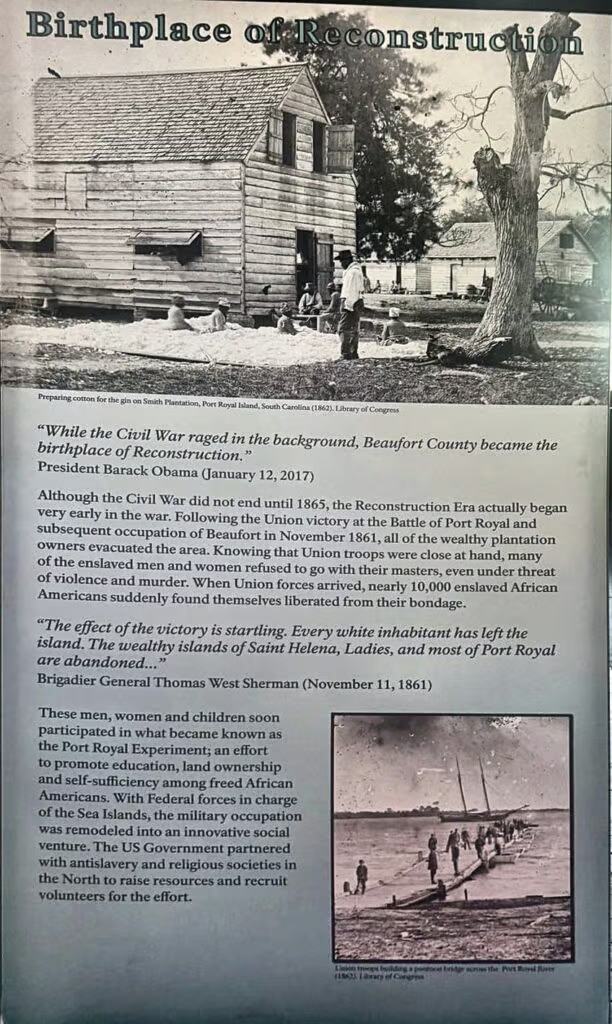
This is the place where Reconstruction began. After the Union victory at Port Royal in November 1861, the plantation owners fled, and roughly ten thousand enslaved people on these islands were suddenly free — two years before the war ended. What followed was called the Port Royal Experiment: an effort toward education, land ownership, and self-sufficiency.
Black people owned land here. They built schools. And Penn trained midwives — the women the island called Granny midwives, photographed there as early as 1910 learning modern hygiene alongside what they already knew. Penn remained a midwifery training site for decades. In a county where Black families had almost no access to doctors, those women delivered the babies.
Public health physicians, among them Dr. Hilla Sheriff, worked alongside Penn to teach hygiene, medical safety, and literacy. They documented and studied what the midwives already did, and built it into a statewide network that drove maternal and infant deaths down.
The most famous of these women was Maude Callen. Born in Quincy, Florida in 1898, orphaned at six, one of thirteen sisters. She came to Pineville in Berkeley County — one of the poorest counties in South Carolina — as an Episcopal missionary nurse, and became only the second nurse-midwife in the state. She covered four hundred square miles of muddy road. She trained other midwives. She was, as the magazine put it, doctor, dietitian, psychologist and friend to thousands of desperately poor patients, only two percent of whom were white.
And here is where my two posts collide. Maude Callen became known to the country because of a twelve-page photo essay in LIFE magazine, December 3, 1951, photographed by W. Eugene Smith. Readers in all forty-eight states sent money. More than twenty thousand dollars. The Maude Callen Clinic opened in 1953.
Last month I wrote about Dolores Allen Littles, born in Hempstead, who went to work at LIFE in 1954 and rose to Director of Photography for Time-Life Books. I said then that what LIFE chose to cover mattered. Here is the proof, three years before she walked in the door.
The cotton
I know you are wondering what all of this has to do with cotton bedsheets. Stay with me.
At the Penn Center I learned about cotton cultivation. Before the Civil War, enslaved Africans on these islands produced the finest cotton in the nation — Sea Island cotton, an extra-long-staple variety the barrier islands were uniquely suited to grow. It was the most valuable cotton in the world.
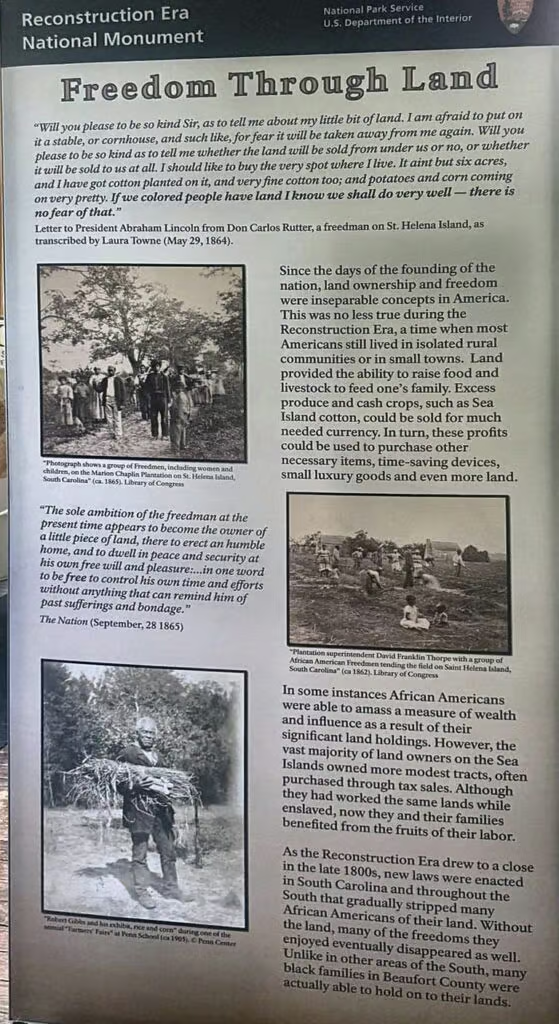
Read what that man wrote. He is asking the President of the United States whether he may keep six acres:
“Will you please to be so kind Sir, as to tell me about my little bit of land. I am afraid to put on it a stable, or cornhouse, and such like, for fear it will be taken away from me again… It aint but six acres, and I have got cotton planted on it, and very fine cotton too; and potatoes and corn coming on very pretty. If we colored people have land I know we shall do very well — there is no fear of that.”
Don Carlos Rutter to President Abraham Lincoln, transcribed by Laura Towne, May 29, 1864
He was seeking reassurance that it would be safe to build on his own land.
An emancipated man who already knew how to cultivate that ground — the skill was never in question, it was his all along — asking only for assurance that he would be allowed to use it.
That cotton industry was broken by the Civil War and finished off by the boll weevil, which reached the Sea Islands around 1920. A small batch is still produced today.
So I went looking for sheets made from the cotton my ancestors cultivated.
The cheapest set I found was seven hundred and fifty dollars.
Needless to say, I will not be sleeping on South Carolina cultivated cotton.
But here is what I did not know
I had reached for Egyptian cotton because that is what we are taught to reach for. It turns out Egyptian cotton descends from Sea Island cotton.
In the early 1800s, Muhammad Ali Pasha imported Sea Island seed into Egypt. It hybridized in the Nile Delta and became the Giza varieties the world now calls the finest cotton on earth. Later, after the boll weevil destroyed the American crop, growers carried Egyptian seed back across the Atlantic to Arizona, where it became Pima. Sea Island, Egyptian, Pima — all of it is one species, Gossypium barbadense.
Even if I buy Egyptian cotton bedsheets, a little of my ancestors is in those fibers.
I did not wander from cotton to the Penn Center by accident. My ancestors guide my footsteps as I search for their stories.
Camp Saxton
There is one more place on this island I want you to see.
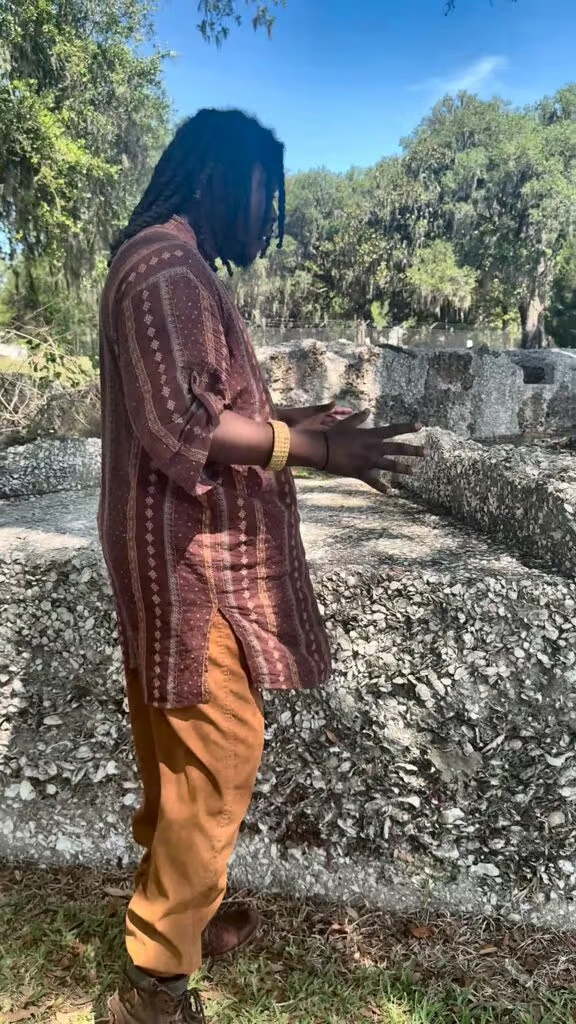
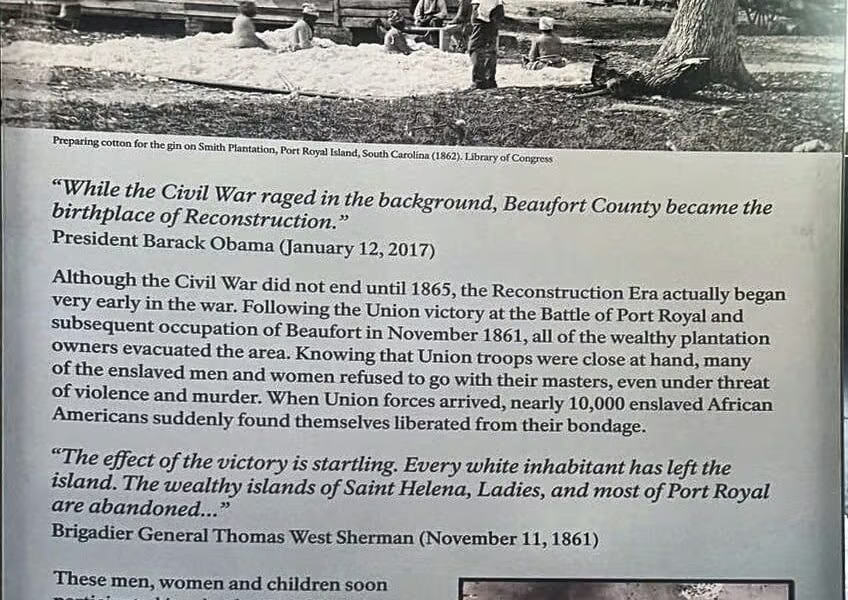
Camp Saxton, part of Reconstruction Era National Historical Park, stands on what had been the John Joyner Smith plantation — the same plantation in that 1862 photograph of cotton going to the gin.
On January 1, 1863, under the oak trees there, the Emancipation Proclamation was read aloud. It was read to the men of the 1st South Carolina Volunteers, a regiment of formerly enslaved men from these very islands. And it was read to the thousands of other people who came to hear it — enslaved and free, men and women. It was the first reading in the Confederate South. Those trees are called the Emancipation Grove.
And the wall behind Tendaji Bailey is Fort Frederick, the oldest surviving tabby structure in South Carolina. The British commissioned it in 1733 and the British paid for it, but African hands built it. Tabby is made of lime, sand, water and oyster shells. Tendaji Bailey, a Gullah Geechee descendant of enslaved Africans, reports that this is a building technology carried here from West Africa.
On that New Year’s Day, people walked across a dock laid over the top of those tabby walls to come ashore and hear that they were free.
The wall they crossed is still standing. The man telling me about it is descended from the people who built it.
Why any of this matters
I started with bedsheets.
Two hundred dollars, four hundred, seven hundred and fifty — and underneath the price was a seed that crossed an ocean twice, a man asking permission to build a stable on his own six acres, a school bought from a freedman, women who delivered a county’s babies, a magazine that decided they were worth seeing, and a wall of oyster shells that people walked across to hear they were free.
This is what I want our scholars to carry. Not that history is in a book, but that it is in the sheets, the seed, the shells, the wall. That the ordinary objects around them have origins, and the origins have people in them, and some of those people are their own.
History is never far away. You just have to be willing to follow the thread when it tugs.
I hope you will join me on this learning journey toward a better world.
Sources and thanks. Penn Center, St. Helena Island · Reconstruction Era National Historical Park and the National Park Service · Fort Frederick Heritage Preserve, Port Royal · Tendaji Bailey · W. Eugene Smith, “Nurse Midwife,” LIFE, December 3, 1951 · the South Carolina Encyclopedia. Exhibition panels photographed by the author.
© 2026 Dr. Tyra Àkànké Washington · B.E.S. Instructional Framework™