LEARNING OUT LOUD · POST THREE
Eight Black women swept Georgia. A week later, a man won a Senate seat in Mississippi and opened his speech with a name from our fourth-grade curriculum.
Dr. Tyra Àkànké Washington · Creator of the B.E.S. Instructional Framework™
“I’m tired of folks… them close-minded folks. It’s like we got a demo tape and don’t nobody wanna hear it. But it’s like this — the South got something to say. That’s all I got to say.”
André 3000 of OutKast, accepting Best New Rap Group at the 1995 Source Awards in New York, after the crowd booed them
That quote came from André 3000 at the 1995 Source Awards. OutKast, a Southern rap group, was in New York to receive the award for Best New Rap Group, and they were booed by Northerners. He famously reminded us — the South has something to say.
The South spoke this past Tuesday; this is part of a long tradition of political organizing. Follow me, so we can explore how the South has always had something to say.
I hope you are bringing current events into your classroom and talking with your students about the history that was made in this midterm election. There is a great deal of it.
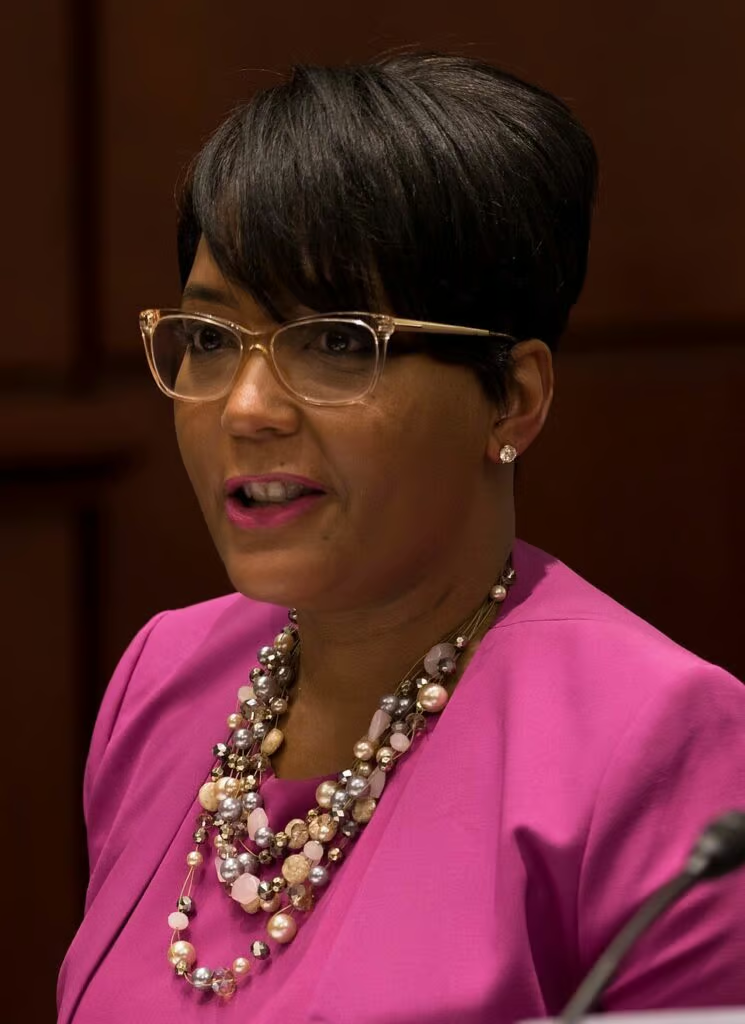
On November 3, Keisha Lance Bottoms was elected Governor of Georgia — the first Black woman elected governor of any state in American history. She is also Georgia’s first woman governor and its first Black governor.
And she did not arrive alone. Eight Black women won statewide office in Georgia that night. Every Black woman who ran statewide in Georgia won.
Tanya Miller, Attorney General — the first woman and the first Black woman ever to hold that office in Georgia. Penny Brown Reynolds, Secretary of State — the first Black person ever elected to it in Georgia, which means the state’s chief elections officer. Keisha Waites, Insurance Commissioner. Nikki Porcher, Labor Commissioner. Katherine Juhan-Arnold, Agriculture Commissioner. Sheila Edwards, Public Service Commission. And Lydia Powell, State School Superintendent — which ought to matter to every educator reading this.
Come January, women will hold seven of Georgia’s eight major statewide executive offices.
Then, eight days later, Mississippi.
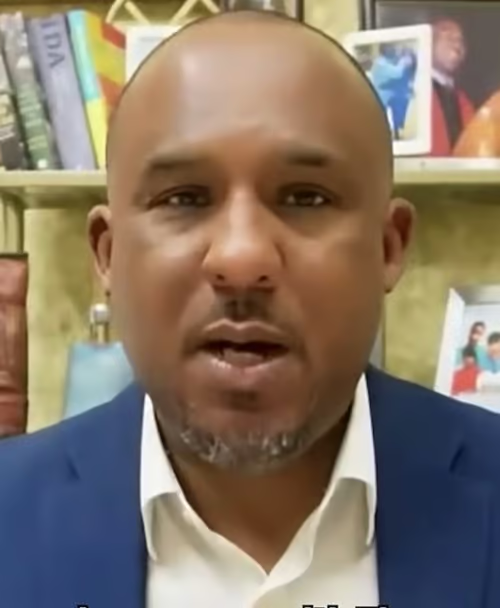
On November 11, 2026, the Associated Press called the Mississippi Senate race for Scott Colom.
He gave his victory speech at Tougaloo College, a historically Black college in Jackson. And he opened it, before anything else, by saying this:
“For people that don’t know, the first African American to be a United States senator was from the great state of Mississippi.”
Senator-elect Scott Colom, November 11, 2026
He was talking about Hiram Rhodes Revels.
I sat up. Because I know that name. Our fourth graders know that name. It is in our curriculum — Grade 4, Unit 3, Lesson 18, and again in Grade 8 as a Scholar Spotlight.
This is how my social studies brain works. I can’t help it. And now you, the reader, will take this journey with me.
Who Hiram Revels was
He was born free in Fayetteville, North Carolina, on September 27, 1827.
I will say that again, because my own family came out of North Carolina before they came to Brooklyn and then to Roosevelt. The first Black man to sit in the United States Senate was a North Carolina man.
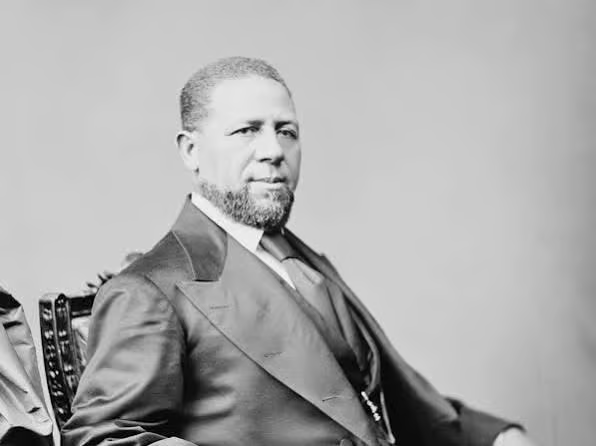
He was ordained a minister in the African Methodist Episcopal Church in 1845. During the Civil War he recruited soldiers for the Union Army and served as a chaplain to a Black regiment in Mississippi. After the war he settled there.
And here is how he became a senator. In January 1870, Revels was asked to deliver the opening prayer before the Mississippi State Legislature. One account of that morning says the prayer was one of the most eloquent ever delivered in that chamber — and that the prayer itself made him a United States Senator. Weeks later, the legislature chose him.
When he walked into the Senate chamber to be sworn in, the galleries applauded. Senators had spent days arguing he could not be seated — that under Dred Scott he had not been a citizen for the required nine years. He was seated anyway.
In his first speech on the Senate floor, he called the Black residents and the white residents of Mississippi “fellow citizens.” He could not have said that accurately two years earlier. The Fourteenth Amendment was that new.
He served about a year, finishing an unexpired term. Then he went home and became the first president of Alcorn, a Black college.
The detail I did not expect
Mississippi sent a second Black senator during Reconstruction. Blanche K. Bruce, born into slavery, chosen in 1874. He served a full term and left office in 1881.
Then nothing. For one hundred and forty-five years.
But here is the part that stopped me, and it is the part I want our scholars to catch.
Revels and Bruce were never elected by the people of Mississippi. Before the Seventeenth Amendment, state legislatures chose United States senators. A Republican-controlled legislature sent them both.
Scott Colom is the first Black senator from Mississippi that Mississippi voters themselves chose.
So the gap is not simply 145 years. The first appointment came in 1870. The first election came in 2026. Those are two different measures of a country, and the distance between them is the whole story of Reconstruction and what happened to it.
What was built
Our Grade 4 lesson on this period is titled “Reconstruction: What Was Built.” Its Big Idea reads:
Reconstruction was the most serious attempt the United States ever made to fulfill the promise of equality. During Reconstruction, Black men voted and held office across the South. Hiram Revels and Blanche Bruce served in the US Senate. Black schools and colleges were built. Black churches became centers of community life. Black land ownership expanded. For one extraordinary decade, the United States tried to become what it had promised to be.
B.E.S. Grade 4 · Unit 3 · Lesson 18
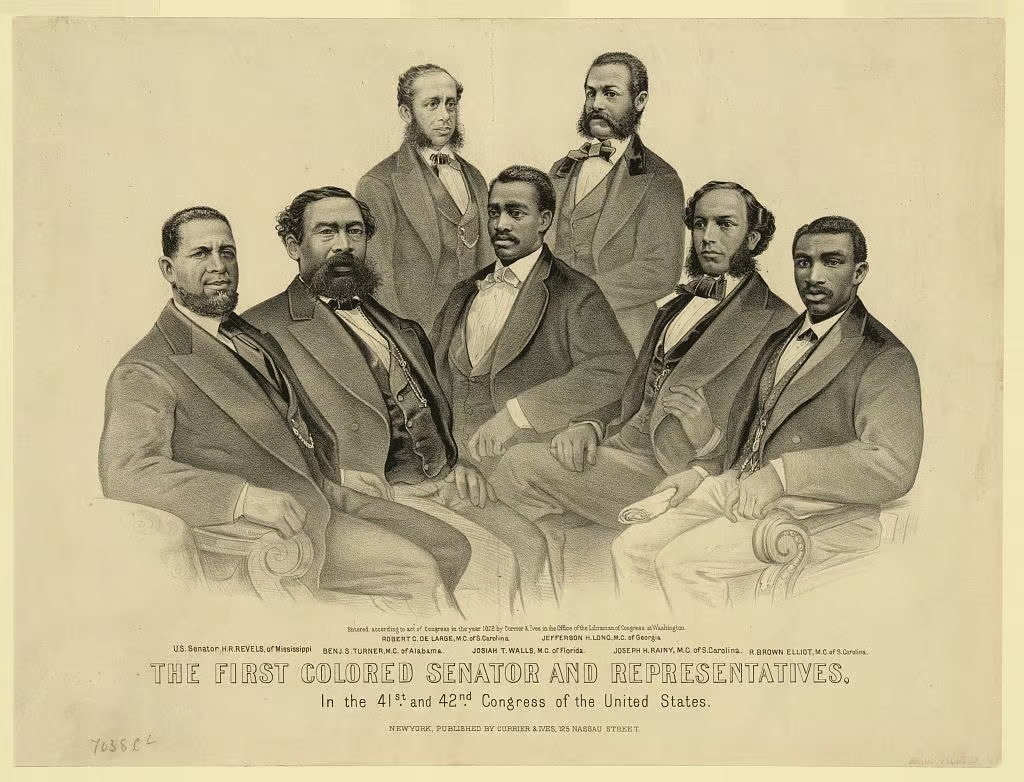
More than two thousand Black men held elected office across the South in those years. Then it was taken apart — by law, by fraud, and by violence — and the taking apart held for a century and a half.
The HILL focus assigned to that lesson is Joy.
I want to explain that choice, because it is deliberate. We do not teach Reconstruction only as a betrayal. We teach it first as a thing that was built — by people who had been property a decade earlier, who opened schools and churches and bought land and sent two of their own to the Senate. The betrayal is the next lesson. The building comes first, and it belongs to the children as inheritance rather than as grief.
Why any of this matters
Colom also named Medgar Evers and Fannie Lou Hamer in that speech. Hamer is in our Grade 8 curriculum — her 1964 testimony before the Democratic National Convention.
A fourth grader using the B.E.S. curriculum will learn the name Hiram Revels. Unit 3 does not arrive until the new year. But in January, when that lesson comes up, their teacher will be able to say: a man won a Senate seat in Mississippi this November, and the first thing he did was say this man’s name.
This is how we make connections and demonstrate that history does not remain in the past. It is still breathing into our present.
The South was speaking in 1870, when Hiram Revels took a Senate seat and the chamber argued for days about whether he was even a citizen. When his term ended he went home to Mississippi and became the first president of Alcorn — and eighty-two years later a young veteran named Medgar Evers graduated from the college Revels built, went to work for the NAACP, and was murdered in his driveway for it.
The South was speaking in 1964, when Fannie Lou Hamer sat before the Credentials Committee and described what Mississippi did to her for trying to register, and the President called a press conference to get her off the air.
The South was speaking last Tuesday, when eight Black women won statewide office in Georgia. And it was speaking again on Wednesday, when Scott Colom took a microphone in Jackson and the first thing he did with it was hand it back to 1870.
Thirty-one years ago a twenty-year-old from Atlanta stood in a New York theater, got booed, and told the room the South had something to say. He meant hip-hop. But the South has always had something to say, and Black Southerners have always inserted their voice and demanded a government that addressed their needs. That fight is not over.
History is never far away.
I hope you will join me on this learning journey toward a better world.
Sources. Associated Press, CNN, NPR, Roll Call and MS NOW coverage of the Mississippi Senate result, November 11, 2026 · United States Senate Historical Office · Congressional Record tribute to Hiram Rhodes Revels · B.E.S. Grade 4 Unit 3 Lesson 18 and Grade 8 Unit 1.
© 2026 Dr. Tyra Àkànké Washington · B.E.S. Instructional Framework™